
Key Takeaways
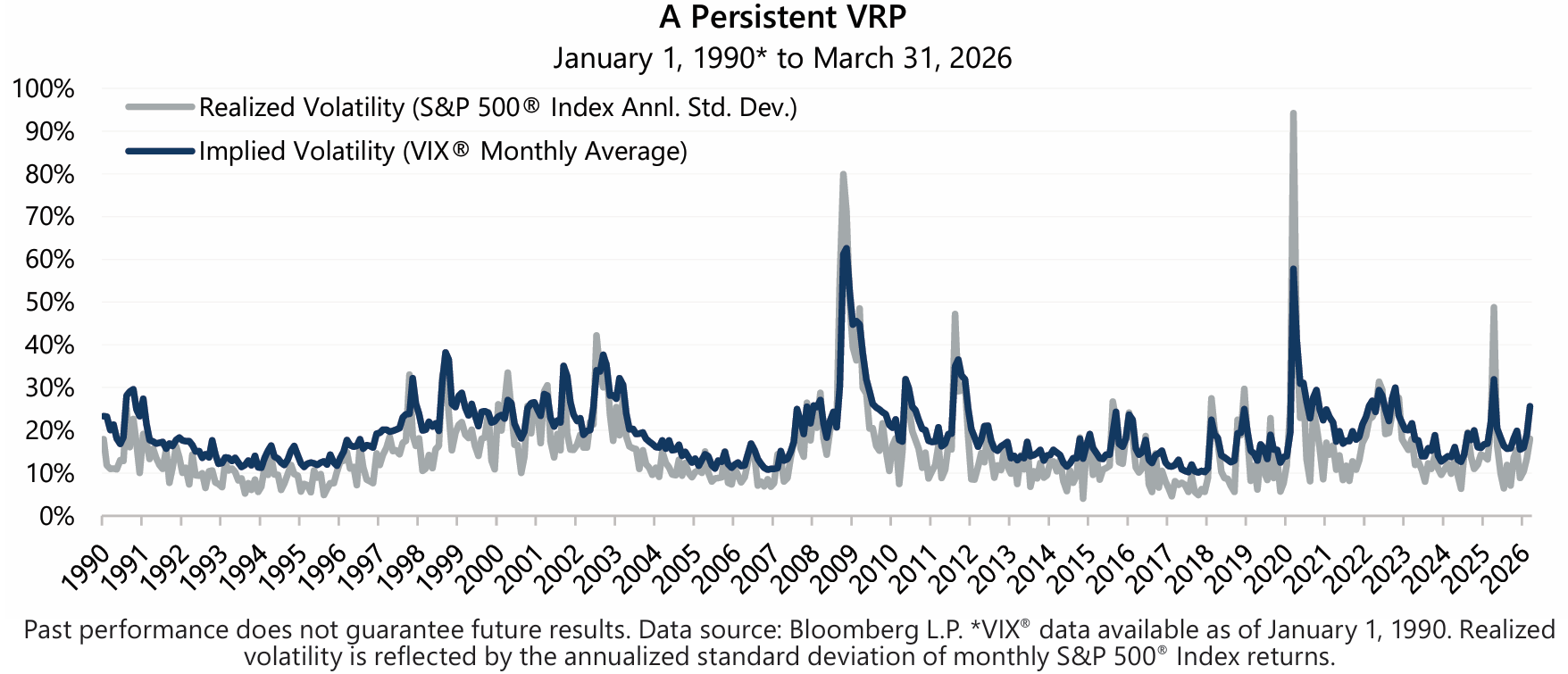
- Historical data shows that implied volatility has exceeded realized volatility over 89% of the time since 1990, creating a persistent premium for disciplined options sellers.
- With implied volatility recently spiking, active options-based strategies have demonstrated an ability to provide portfolio durability during periods of heightened market unpredictability
- By capturing the 4% average monthly gap between implied and realized volatility, or the Volatility Risk Premium (VRP), investors can mitigate equity risk without fully sacrificing long-term growth potential.
Volatility has been robust in 2026, with implied volatility averaging 20.43 from the start of the year through March 31 – peaking at 31.05 during the drawdown in March. This is just one result of the inherent unpredictability that is persistent in equity markets. For investors looking to manage risk but remain in equities, active options-based strategies can provide a level of durability to help navigate market turmoil.
The Volatility Risk Premium
The case rests on a persistent arbitrage opportunity and an understanding of potential performance across varying equity market environments.
Options thrive on a well-documented anomaly: implied volatility has almost always exceeded realized volatility (standard deviation). In fact, this has occurred more than 89% of the time since the inception of the VIX® in January 1990. The gap between implied and realized volatility — the VRP — reflects persistent excess demand for index options from buyers seeking insurance-like protection. This has created a structural market dynamic where sellers can collect the VRP, which has a monthly average of 4% since 1990.
Consistency & Durability
Equities are risky – but they are also a reliable source of returns. Despite short-term risks, diversified equity portfolios have historically outpaced inflation over time. The good news is that combining equity exposure with index options can help mitigate losses while continuing to benefit from long-term market growth.
Regardless of market direction, a disciplined and actively managed options-based strategy – backed by an experienced and focused team – is a compelling source for portfolio durability. Consider the following five market environments and expected results based on trailing 12-month performance since January 1988:
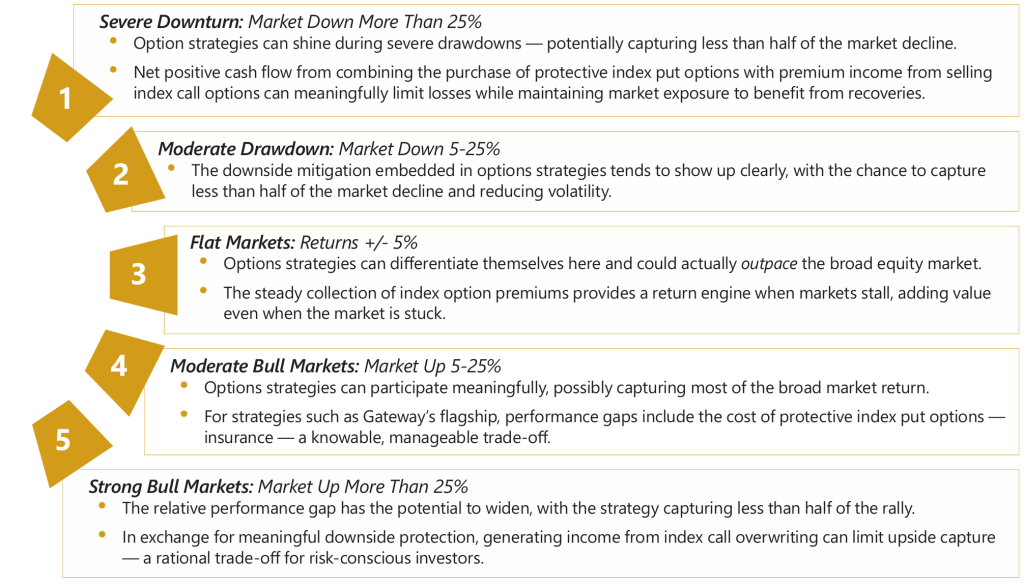
In four of five environments, Gateway’s flagship strategy was able to provide significant loss mitigation while maintaining strong up-market participation – either outperforming (in flat markets) or capturing a majority of the equity market advance. In only one environment, strong bull markets, does the rational choice of paying for insurance have the potential to widen the gap in relative performance.

Go With the Experts
Actively managed options-based equity strategies offer a distinctive combination: genuine downside protection, income generation, and meaningful participation — all at significantly lower volatility than the broad equity market. For risk-conscious investors looking for a more durable path through market uncertainty, these strategies merit consideration.
Founded in 1977, Gateway is a pioneer in options-based investing – first using options shortly after Cboe® began trading modern contracts. Over nearly 50 years, the firm has developed a single-source, unified framework for alpha and risk management, applying a rigorous, quantitatively driven approach to navigate market complexities and unlock value.

Past performance does not guarantee future results. Gateway does not provide tax advice. Tax treatment and rates can and do vary over time. Investment decisions should be made based on an investor’s objectives and circumstances and in consultation with his or her investment and/or tax advisors. Data sources: Bloomberg, L.P. and Morningstar DirectSM.
The Cboe® Volatility Index (the VIX®) is a financial benchmark designed to be an up-to-the-minute market estimate of expected volatility of the S&P 500® Index and is calculated by using the midpoint of real-time S&P 500® Index (SPX) option bid/ask quotes. More specifically, the VIX® is intended to provide an instantaneous measure of how much the market thinks the S&P 500® Index will fluctuate in the 30 days from the time of each tick of the VIX®.
The Bloomberg® U.S. Aggregate Bond Index (Agg Index) is a broad-based index that covers the U.S.-dollar-denominated, investment-grade, fixed-rate, taxable bond market of SEC-registered securities. The index includes bonds from the Treasury, government-related, corporate, mortgage-backed securities, asset-backed securities, and collateralized mortgage-backed securities sectors. BLOOMBERG® and the indices referenced herein (the “Indices”, and each such index, an “Index”) are service marks of Bloomberg Finance L.P. and its affiliates (collectively “Bloomberg”) and/or one or more third-party providers (each such provider, a “Third-Party Provider,”) and have been licensed for use for certain purposes to GATEWAY INVESTMENT ADVISERS, LLC (the “Licensee”). To the extent a Third-Party Provider contributes intellectual property in connection with the Index, such third-party products, company names and logos are trademarks or service marks, and remain the property, of such Third-Pary Provider. Bloomberg or Bloomberg’s licensors own all proprietary rights in the Bloomberg Indices. Neither Bloomberg nor Bloomberg’s licensors, including a Third-Party Provider, approves or endorses this material, or guarantees the accuracy or completeness of any information herein or makes any warranty, express or implied, as to the results to be obtained therefrom and, to the maximum extent allowed by law, neither Bloomberg nor Bloomberg’s licensors, including Third-Party Provider, shall have any liability or responsibility for injury or damages arising in connection therewith.
Gateway Investment Advisers, LLC (Gateway) is an independent registered adviser and a successor in interest to Gateway Investment Advisers, L.P. as of February 15, 2008. Performance information for the Gateway Quality Income Composite are based on a Gateway internally-funded portfolio that has been in existence since May 1, 2023.
The “S&P 500” is a product of S&P Dow Jones Indices LLC or its affiliates (“SPDJI”), and has been licensed for use by Gateway Investment Advisers, LLC (Gateway). Standard & Poor’s® and S&P® are registered trademarks of Standard & Poor’s Financial Services LLC (“S&P”) and Dow Jones® is a registered trademark of Dow Jones Trademark Holdings LLC (“Dow Jones”). These trademarks have been licensed to SPDJI and have been sublicensed for use for certain purposes by Gateway. Gateway Quality Income is not sponsored, endorsed, sold or promoted by SPDJI, Dow Jones, S&P, their respective affiliates, and none such parties make any representation regarding the advisability of investing in such product nor do they have any liability for any errors, omissions, or interruptions of the S&P 500 Index. S&P 500® Index is a widely recognized measure of U.S. stock market performance. It is an unmanaged index of 500 common stocks chosen for market size, liquidity, and industry group representation, among other factors.
REQ-MISC